Arc 3 Communications

  • Home
  • About Us
    • Our Founder
    • Our Approach
    • Our Values
  • Services
    • Content
    • Digital
    • Advocacy
  • Our Work
    • Content
    • Digital
    • Advocacy
  • Blog
    • Archive Page
  • Contact Us

Key Tips for Ensuring Your Association’s Digital Marketing Efforts Are Compliant

July 21, 2021 By Patrick L. Burns Leave a Comment

In today’s world, much of the interaction we do with each other is through digital means. From social media to email, blogs to newsletters, many of your association’s marketing efforts are most likely digital. Both communicating with and providing value for your members, while also bringing in new members is achieved through digital marketing efforts. Ensuring your association’s digital efforts are compliant with laws and regulations regarding privacy rights and data is vital to protecting your association’s reputation and also your members.

In recent years, privacy rights and data protection have become key issues in the United States and globally. In 2018, the California Consumer Privacy Act (CCPA) was passed that “gives consumers more control over the personal information that businesses collect about them.” In 2016, the General Data Protection Regulation (GDPR) became law in Europe. Like the CCPA, this regulation aims to give consumers more control or personal information, but also addresses the transfer of personal information outside of the European Union and European Economic Areas (EEA).

Being informed of privacy laws and regulations and making sure your digital efforts are compliant will not only help avoid legal issues but will protect relationships and trust with your members. While there are many requirements within these regulations, we have featured below a couple of key areas to be aware of when it comes to making sure your digital marketing efforts are compliant.

Email Marketing  

Email marketing is a major part of what associations do to provide news and information while also recruiting new members. One thing to be aware of when it comes to email is that there are strict anti-spam laws in the United States that you must follow to avoid hefty fines and a damaged reputation. The U.S. CAN-SPAM act, according to the Federal Trade Commission, is a law that sets the rules for commercial email, establishes requirements for commercial messages, gives recipients the right to have you stop emailing them, and spells out tough penalties for violations.

This law can easily be followed by only including people on your email lists who have opted into your email program. A few more factors to this law are that you are honest with your headers and subject lines, tell the recipients where you’re located, and if the email is an advertisement that you make that clear. As before mentioned, offering a clear and easy opt-out is also required and once that action is taken, emails must promptly cease.

Follow these rules, act in an ethical and respectful way, and your email program will reflect your association’s values.

Member Privacy and Data

A big issue in today’s society is that of privacy and data. Who has the right to your data and what do those who get access to your data do with that information? These questions have been at the forefront of everyone’s mind with the rise of social media platforms and Google. Whereas you as an association may not have access to that level of personal data; members do entrust you with sensitive information such as their names, addresses, emails, phone numbers, credit card information, and more. Protecting this data also protects your association’s reputation and will lead to trusting relationships and increased membership.

One way you can ensure member data is protected is to make sure you have a secure website. According to Hosting Tribunal, nearly 33 percent of websites have inadequate security. An easy way to tell if your website is secure is to look at your URL in the address bar, if your website is an HTTPS (Hypertext Transfer Protocol Secure) website as opposed to an HTTP website, your website is encrypted using Transport Layer Security (TLS). Other factors play into website security such as regular website maintenance, updating plug ins, and ensuring your hosting company has good security offerings.

You should never share, sell, or make public any sensitive member information. This will not only put you in hot water with your members, but also with the law. Overall, ensuring you have a secure website and that you treat member data responsibly, you will protect your reputation and your member’s well-being while building lasting relationships.

Compliance is Key

Compliance with privacy and data laws is vital to a successful digital marketing strategy and also to protecting your members privacy and your association’s credibility and reputation. While we have not discussed all compliance requirements, these are a couple of key areas to be aware of. Government websites are a reliable source for reading up on these laws, especially those applicable to your geographic location, and checking to make sure your association is fully compliant.

For help with your association’s digital efforts contact us here. For more information regarding our content, digital, and advocacy services for associations, visit our website.

Filed Under: Public Affairs Tagged With: Associations, associations and digital, digital, Digital Marketing, public affairs, public affairs and digital

How to Create a Strong Social Media Policy for Your Local Government

June 22, 2021 By Patrick L. Burns Leave a Comment

A social media policy is a code of conduct that provides guidelines for employees when it comes to posting content on the internet, whether personally or professionally. The goal of such a policy is to protect against legal issues or public backlash that may result from employees posting inappropriate or sensitive information. Social media policies for local governments not only protect the image of the community and its representatives and professional staff, but also encourage government employees to share credible news, events, and useful information about the city or county on their online networks.

Control of Your Local Government’s Official Accounts

One aspect of your local government’s social media policy should be to establish who controls the government or department’s official social media program. This decides who has permission to create and deactivate official social media accounts; who can create and implement the social media strategy; and who can develop and enforce the social media policy.

There are two types of control you may decide to set up for your local government’s social media programs, centralized and decentralized. Having centralized control means you determine a single authority to have control over the creation of all accounts and require review by that authority of all posts or comments on the government’s behalf. This type of control can greatly reduce the risk of something being posted or shared that may be a liability. By having this form of control, a single authority can be held accountable for all social media activity. This single authority often times consists of a city of county’s communications team.

The other type of control is decentralized. This simply allows multiple department entities to have access to sharing and posting. For example, if the parks department wants to tweet about an upcoming event and the local police want to tweet alerts and updates, each will be granted permission to do so and trusted to abide by the social media policy. You can also have a combination of both where different departments may have access but posts still must be approved by a central authority.

A centralized approach tends to work best for small governments who may use their social less frequently and may only have a single Facebook page. Decentralized tends to make things easier for larger governments that have multiple departments and as a result, multiple social media pages across platforms.

Your Local Brand, Public Record, and Sensitive Information

Like with your personal social media accounts, your local government’s social media accounts reflect on your city or county, so it is vital to make sure anything that is shared or posted represents your local communities’ values. It is always important to think before you post, if you have to question it, it probably isn’t appropriate to share. According to the National League of Cities, some actions that are important to avoid are disinformation that may mislead and cause harm to the public, sharing private or confidential information, harassment and defamation, and violation of intellectual property rights.

It is important to set clear guidelines and rules for citizens, public employees, and elected officials who are utilizing your local government’s social media, whether on the content production end or as the consuming audience. Be sure to be specific and detailed regarding what sort of content can be posted and what kind of policies are in place when it comes to making and deleting comments. According to American City and County, local governments can run into legal trouble when an action taken on a social media page is seen as infringing on a citizen’s First Amendment rights, like deleting a comment.

Some recent court cases have decided that city, county, and even elected official social media pages are considered limited public forums of speech, and that citizens have the right to free speech when posting on them. Therefore, having clear and concise rules in the form of a legal social media policy can help protect your local government from any legal issues.

Protecting sensitive information is also vital when running your local government’s social media pages. With COVID-19, many citizens were getting all of their news and updates from digital channels including social media pages. This is exactly what these pages should be utilized for, but those with access and permission to post on behalf of the local entity must also be careful not to share any information that may be confidential or sensitive information.

This also applies to government employee’s personal social media accounts. Rules need to be in place regarding what employees can and can’t share, regarding government information, on their personal social media accounts. Also, as employees, their social media accounts reflect on the city or county as well, so nothing should be shared or posted that casts a negative light on the community. Rules regarding this can also be included in the social media policy.

Social Media Policies Protect Local Governments

Recently, the Cobb County School System in Georgia created and passed a new social media policy for their school district. According to an article in the Atlanta Journal-Constitution, this policy sets rules for Cobb County School District employees and prohibits them from making posts that harm or discredit the system or reputation of the school district. Violation of rules and guidelines outlined in the social media policy carries consequences that range from a written warning to the termination of employment. This helps ensure that posts made by employees of the Cobb County School District positively represent the schools within the district as well as the school system as a whole.

Social media policies protect local governments from liability that may come with issues that can arise from inappropriate social media posts. These policies help make sure that professional and personal social media accounts reflect positively on the government entities that the accounts and people represent. Having a policy ensures that your local government’s brand, credibility, and image are protected and allows things to run smoothly.

If you need help drafting or implementing a social media policy for your local government, contact us here.


Filed Under: Government, Public Affairs Tagged With: Government, Local Government, public affairs, social media, Social Media and Government, Social Media and Public Affairs, Social Media Policy

Should Associations Spend All of their Advertising Dollars on Facebook?

May 27, 2021 By Patrick L. Burns Leave a Comment

In the recent U.S. Elections, Facebook decided to pull the plug on political advertising. During this moratorium, an issue arose when it came to what constitutes as political advertising and what is in fact simply news. News story posts that mentioned politics or issues were being blocked and placed in the same category as paid political advertising when, in fact, they weren’t. This raised the question “Is Facebook a media outlet that can decide what it wants to support and censor or are they the free platform they claim to be?”

Facebook has been called out in the past for archiving promoted news stories that cover politics or issues as political advertising. This brought push back from many journalism and news associations. It also raised the question of how much regulation can Facebook enforce on policy issues and associations it may disagree with. For example, if Facebook supports the Go Green initiative, could it eventually censor ads from associations that may represent things it deems harmful to the environment? This then causes one to ask, should associations put all their advertising assets into Facebook?

While Facebook ads can be a good way to spend association ad dollars, it is good to know your options in case policies change or they decide to censor issues important to your association. Google Ads are a viable option for reaching members and policy allies and allows you to tailor your ads to display to a specific audience or audiences. Some are shifting away from Facebook due to privacy and effectiveness issues. A recent survey by Inc. reported that 32 percent of CEO and senior-level executives surveyed said they are now getting less for their marketing dollars with Facebook than they used to, while 27 percent said they mistrust Facebook’s use of their business data.

With increasing advertising costs, noise, and fear of censorship from Facebook, it could be worth looking into alternate ways to spend your association’s marketing dollars. Putting resources into search engine optimization efforts and content marketing can be very effective means to attracting new members, and as before stated, Google Ads is another option for advertising. This isn’t to say you should completely cut Facebook advertising out of your marketing strategy if it works for your association; but it is always wise not to put all your advertising eggs in one basket.

Need help diversifying your digital strategy for your association? Contact us here.

Filed Under: Public Affairs Tagged With: advertising, Associations, associations and social media, Digital and Public Affairs, Facebook, public affairs, social media

Which States are Gaining or Losing Seats in the Next Congress (Infographic)

May 18, 2021 By Patrick L. Burns Leave a Comment

Filed Under: Government, Public Affairs Tagged With: Congress, Government, public affairs, U.S. Government

Website Development Case Study: North Carolina Aggregates Association

May 14, 2021 By Patrick L. Burns 31 Comments


The North Carolina Aggregates Association (NCAA) is the leading advocate for the aggregate industry in the state of North Carolina. It is a non-profit, member-driven association that has both producer and associate members. The mission of the NCAA is “promoting the environmentally sound, responsible and economically viable extraction of crushed stone, sand and gravel for use in all types of construction for public benefit and for positive statewide economic development.” North Carolina is one of the largest crushed stone producers in the United States.

The NCAA is a non-profit trade association incorporated in 1964. During the past 60 years, consumption of aggregates per capita has increased from 3.5 metric tons per year to over 10 tons annually. Companies engaged in the production and/or sale of crushed stone, sand and gravel in North Carolina make up the association. Environmental programs in legislation; marketing and public relations; technical specifications, safety and health, air, and water quality; mining and reclamation; transportation and research are all services offered to member companies, specifiers, and users of aggregate products.

With the aggregate industry experiencing renewed optimism,  the NCAA wanted to reflect this by updating their communications with a redesigned website. They wanted the new site to be mobile friendly and present content to their members in a way that made information easy to find while being aesthetically pleasing as well. Arc 3 Communications worked hand in hand with NCAA to create a website that represented their brand and gave them a strong new visual identity. Many features such as a slider of member logos, an interactive calendar of events, easy to navigate menu, and membership sign-up were incorporated to create a successful and informative user experience.

The North Carolina Aggregates Association’s new website resulted in substantial growth in unique visitors and page views to the site. NCAA’s website has provided a new strong visual brand identity for the association that stands out and represents them well. Most importantly, NCAA’s new website has resulted in an increase in member engagement, greater awareness about the aggregate industry among key partners, state legislators, and civic leaders; and more associate membership leads.


Filed Under: Our Work, Public Affairs Tagged With: Associations, Digital and Public Affairs, public affairs, Trade Associations, Website

How to Tell the Difference Between Real and Fake News Online (Infographic)

May 10, 2021 By Patrick L. Burns Leave a Comment

In this day and age of unlimited information at our fingertips, readers need to take time and do a little research to verify the news they are reading and sharing with others is, in fact, real news from a credible source. Below are a few steps you can take to make sure the information you are receiving and sending is reliable and true.

Filed Under: Government, Public Affairs Tagged With: Associations, Digital and Trade Associations, Digital Gov, News, online, public affairs, social media, Trade Associations

How to Increase Association Members’ Value with a Strong Content Strategy

March 19, 2021 By Patrick L. Burns Leave a Comment

Content strategy is vital for your trade association, not only to bring in new members, but also to provide your current members with value for their membership. Just like other aspects of your organization, having a detailed and planned content strategy allows you to develop and put out content in a way that will draw the attention of your audience; attract new members; and provide your current members with valuable resources and information. Creating and releasing content without a strategy makes it difficult to track success; and also makes it difficult for your members to follow your content schedule, or lack thereof.

Below we will discuss ways to put together a content strategy that will allow you to test methods and see results. This will help you plan, create, and track your content marketing efforts and make tweaks where needed to reach your goals.

Planning and Goal Setting

First things first, you have to work with your team to pinpoint the ultimate goals you are trying to reach with your trade association’s content marketing efforts. Whether you are trying to bring in new members, raise awareness, provide value, promote an event, or a mixture of things; having them laid out allows you to plan your content efforts with these goals in mind. This lends purpose to your content creation and distribution strategy, instead of just posting content to get it out there.

Part of this process is identifying your audience. Consider the age range, background, profession, industry, and any other contributing factors that may affect the type of content you produce. These attributes may also influence the channels you choose to use to distribute your content. Researching information such as this Pew Research Center study on social media use and demographics, can help you decide the appropriate channels to reach your specific audience.

Content Types and the Popularity of Video  

When it comes to the types of content you create and distribute, you may need to experiment to
find out what works for your audience. While blogs and e-newsletters are good staples of content marketing for everyone to have, other content forms such as infographics, videos, photos, live-streams, webinars and more can help diversify and give your content strategy what it needs to cut through the noise. With so much content competing for your audience’s attention, the more you can stand out and draw members’ attention to you, the better. You may have to test multiple content types to gauge what gets the best results.

One of the most popular content forms now is video. According to Small Business Trends, 93% of marketers say video has brought new customers. With current video recording technology, it is possible to make professional looking videos straight from your cellphone. There are a number of different ways you can take advantage of video such as vlogs, behind-the-scenes, interviews, Q&A sessions, how-to videos, and many more. No matter the content path you choose to take, video is a good choice to have on your list.

Content Schedules, Calendars, and Consistency

As you create content, it is important to create a schedule for releases and posts. A good tip is to create and implement a content calendar that keeps track of what content is being posted, on what channel, and on what day. This helps you further strategize by allowing you to plan in advance what content you’d like to share. For example, if you have an upcoming virtual event, you will want to plan content regarding that event strategically leading up to it in order to recruit attendees.

Content buckets are a helpful strategy for organizing your content. Content buckets (remove link) refer to sharing certain subject matter on specific days of the week and can also be planned and tracked through your content calendar. For example, you can decide to always share association news on Monday’s, employee stories on Tuesday’s, industry how-to videos on Wednesday’s and so on. This way your audience will know when to look for the content that is most important to them. Your content buckets can also be tested and changed depending on performance. Always try to have a reason behind your strategic decisions to get the most ROI for your content efforts.

Consistency is key to a successful content strategy. As a trade association, you want your members to get as much value for their membership as possible. You also want potential new members to see that you are the leading authority for your association’s industry. In order for this to be possible, you have to consistently provide new and quality content on a regular basis. If you have an active blog that you post to once a week, try to find what day and time gets the highest traffic, and consistently post your new blog every week on that day and at that time. Again, this allows your members and the rest of your audience to know when to check back for new content.

One Size Doesn’t Fit All

When it comes to content strategy for your trade association, there is not a one size fits all strategy that works for everyone.  If you need help creating and implementing a content strategy that works for your association and would like to learn about our content marketing services, contact us here.

Filed Under: Content Marketing, Digital Marketing, Public Affairs Tagged With: Associations, Content, Content Marketing, Content Marketing and Associations, Content Marketing and Trade Associations, content strategy, Content Strategy and Trade Associations, public affairs, Social Media and Trade Associations

How to Get Your Trade Association’s Content in Google’s Search Position Zero

February 22, 2021 By Patrick L. Burns Leave a Comment

In recent years, Google has been trying to find ways to get people the answers they are looking for without having to leave the Google search engine results page (SERP). One way they use to achieve this is the featured snippet. These can appear with traditional Google searches or voice searches which are growing in popularity. Featured snippets are boxes of text that answer a query and appear above the coveted top three results on the SERP. This has come to be known as “position zero”. These featured snippets pull the answer to the query from a content piece on a website and post the “snippet” along with a link to the full piece in a box at the top of the page. This allows people to get the answers they are looking for quickly without having to go to any website, but if they wish to know more, they can follow the link to the full piece.

While there is no exact science to getting your association’s content into featured snippets, there are things you can do to greatly improve your chances.

Understanding What a Featured Snippet Is

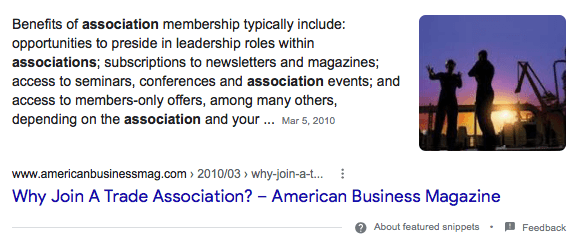
Before you can begin to think about trying to earn a featured snippet, you should know a few things about them. Featured snippets are usually answers to who, what, when, where, why, and how questions. Google ranks websites and content based on the reputation and factualness of the content and from there pulls answers to feature in the snippet. For example:

If you search “Why join a trade association?”

You will see this featured snippet appeared at the top of the page. This particular snippet was pulled from www.americanbusinessmag.com and features a basic answer to the question “Why Join a Trade Association?”. It also gives the user the chance to follow the link to learn more, thus increasing chances of someone visiting your website.

Snippets can appear in different forms including paragraph snippets like the one above, numbered or bulleted lists, and tables. Which snippet type that your content is featured in will depend on the type of content you create.

How to “Own” the Featured Snippet

As previously stated, there is not an exact science to winning the featured snippet, but there are steps you can take with your association’s content to increase your chances.

  1. Find out what people want to know

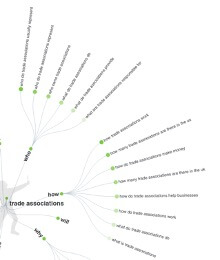
For this first step, you really have to think like your audience; this could be existing members or potential members. Think of the questions you receive and try to focus strong content around answering those questions. Again, featured snippets are answers to who, what, when, where, why, and how questions. Keep this in mind when brainstorming potential audience questions. A good resource for finding what people are asking is www.answerthepublic.comwhere you can search specific terms and see what people are searching for regarding that term.

We searched “trade associations” and you can see a part of the wheel we got as a result. This image includes the who and how results. One popular question is “what do trade associations do?” so that may be a good topic for content for you to focus on.

  1. Research Snippets in Your Industry

A good way to find opportunities for snippets for your association is to go to Google and begin typing the questions that you came up with. This will allow you to see if there are existing snippets or if there is an open opportunity for you to own the snippet. Even if there are existing snippets, if you tailor you content right, you can still take control of that snippet. Also be sure to pay attention to the “People also ask” section that appears further down the SERP. Below is the “People also ask” box that appears when we entered the question “What is a trade association?”

This section also pulls from existing content online so there is also potential to have your content featured as an answer here as well.

  1. Strong Website, Strong Content, Strong SEO

One of the most important factors in having your association’s content chosen for the featured snippet is making sure your website is optimized, easy to navigate, and functioning well. This is one of the first things Google looks at when determining whether your page should appear on the first page of the SERP or in the featured snippet. If your website is slow and not user friendly by Google’s terms, even if your content is outstanding, you may be overlooked when it comes to the featured snippet. Not only that, but your website will get pushed further back on the SERP making it hard to find and less likely to be visited.

Also, devoting time to keyword research and using popular keywords in your content will help not only win the featured snippet, but also rank you higher on the Google SERP. Using backlinks, cross-linking, and releasing content consistently and regularly can also go far to increase your ranking and raising you up on the search engine results page (SERP).

You Can Do It

It takes work, but you can earn the featured snippets and even improve your position on Google’s search engine results page at the same time. There are many other factors that improve your chances for securing snippets and improving your SEO. If you would like further information or help with your association’s website or content marketing, contact us here.

Filed Under: Public Affairs Tagged With: Assnchat, Associations, Content, Content Marketing, Content Marketing and Associations, Google, public affairs, SERP, Trade Associations

5 Ways Local Governments Can Improve Their Social Media During COVID-19

January 19, 2021 By Patrick L. Burns Leave a Comment

5 Ways Local Governments Can Improve Their Social Media During COVID-19

COVID-19 has created a major shift to digital when it comes to the way local governments provide services for and engage with their citizens. Local governments are tasked with keeping their citizens safe and informed both regarding the COVID-19 pandemic and the other many services they provide. Local governments must also be responsive to their citizens’ concerns while also working to keep the calm and provide reassurance during challenging times.

One tool that can be utilized by local governments are their various social media pages. Facebook, Twitter, and Instagram are great ways to keep in communication with citizens while also providing important timely information and creating an open dialog for people to voice suggestions and concerns. Below are five useful ways your team can begin utilizing your social media during COVID-19 and beyond.

  1. Emergency Alerts, News, COVID-19 Updates

In these times of uncertainty, it is essential to be able to relate any emergency alerts, updates, and new COVID-19 developments to your community as quickly and efficiently as possible. Not everyone has social media, so it should not be your main line for communicating these items, but it is a useful channel. This can be anything from severe weather warnings to school closures due to COVID-19.

It is important when relaying this type of information to do so in a reassuring and confident tone. Make sure to avoid use of all caps, exclamation marks, or language that may cause panic. You do want to be sure people are aware of any danger or risks and take these seriously, but it is also good to let them know the local government is doing everything it can to help.

  1. Important Meetings

Though meetings and public hearings may not be taking place in person, many local governments are holding official public meetings through Zoom and other virtual meeting platforms. Making sure your citizens have plenty of notice of upcoming virtual public meetings as well as all the necessary details, such as Zoom links and passwords, is crucial to making sure people in the community have the opportunity to attend these meetings and provide public input.

Posting this information on your social media accounts can also allow you to gauge public interest in a policy or topic, answer questions, and get an idea of the things people are saying about an issue by viewing the likes and comments. Be sure to keep a close eye on the comment section, so you can respond in a timely manner and answer any questions that may arise. Speaking of comments, have clear conduct guidelines in place to avoid any misinformation or inappropriate posting on your government’s pages.

  1. Be Open and Responsive


With many local government buildings having limited access to the public, many people may have trouble getting in contact with local officials they would like to talk to. It may not be possible to respond to every comment on each post; but utilizing apps such as Facebook Messenger allows for citizens to send direct messages. These should be checked and replied to in a timely manner as this will build trust while providing answers and letting the people of your community know their voices are being heard.

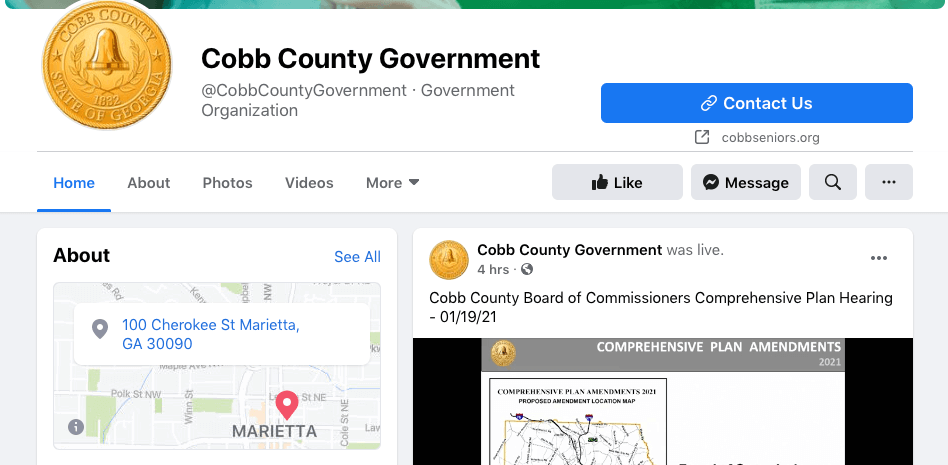
You should also have a visible link to your government’s website and contact us page that will allow an email or direct message to be sent if you
are unable to check the social media messaging apps. A great example is Cobb County, Georgia’s Facebook page pictured below, in which they have multiple options for contacting them prominently at the top of their Facebook page.

  1. Assisting Local Law Enforcement

Another important use for local government social media is assisting local law enforcement in spreading any important alerts or information. They can share missing children alerts, be on the lookout (BOLO) alerts, and even public service announcements and safety tips to help keep the community safe. Many local law enforcement agencies have their own social media accounts, but local government can help by sharing any important public safety messages on main accounts.

Traffic alerts, road closures, and construction news can also be shared to help keep people informed of possible detours, traffic patterns, and accidents in their area. This can help prevent frustration and keep traffic flowing smoothly on local roads.

  1. Messages of Hope and Positivity

COVID-19 has been hard on everyone. It is important to provide hope and positivity for the people of your community and let them know that brighter days are ahead. Things such as inspirational quotes, news about successful fundraisers, happy stories from around town, and messages of positivity from elected officials can go a long way in turning the tide of negativity and allowing you to bring some light into your community. Though times are difficult right now, as communities, we can come together and get through it; people need to be reminded that there is light at the end of the tunnel.

Your local government’s social media accounts are a powerful tool for keeping connected with your community and making sure the wheels keep turning. It also allows the people to know their voices are important and being heard. It also allows your citizens to attend local public meetings and be a part of important decisions that affect their community. And finally, it can bring messages of hope and positivity to your community during these challenging times. So please make sure you are utilizing your local government’s social media accounts, and if you need help with strategies and ideas for your community, contact us here.

Filed Under: Government, Public Affairs Tagged With: Facebook and Local Government, Government, Local Government, public affairs, social media, Social Media and Local Government, Twitter and Local Government

How to Write a Successful Call to Action for Your Association

October 29, 2020 By Patrick L. Burns Leave a Comment

Associations Call to ActionWhen it comes to getting members to engage with your content, whether your blog, e-mail newsletter, event sign-up, or donations, your call to action (CTA) goes a long way. According to Associations Now, getting members to engage starts with compelling them to act. It also helps with member recruitment when trying to get people to become members with your association. The call to action is a powerful tool for you to utilize and there are several tips that can help you build ones that are effective and successful in your mission.

What is a Call to Action?

Your call to action is your chance to persuade your current and potential members to do what you want them to do. Think of it as your “Buy Now” statement. You will include this on everything from blogs, to social media posts, to newsletters. As an association, you should also include CTAs on your website copy to recruit new members or get renewals. A well-crafted call to action will have majority of the people who view your content engaging with and completing the tasks you want them to.

Short and Simple, Yet Informative

A good call to action is short, simple, and to the point. You want to make sure that you give enough information to inform the reader and guide them towards the desired action. You want to make sure the benefits are clear, for example:

“Sign up for our newsletter to receive all the latest association news, useful resources, and event invitations.”

Be sure to include easy to follow instructions to complete the action such as a link, a phone number, email address or a form to fill out. This will make it quick and easy for people to complete the action and increase the likelihood they will go through the necessary steps required.

Use Action Verbs

Wording is everything when it comes to the success rate of your call to action. Action verbs go a long way towards leading people to converting. Phrases such as “Sign up,” “Visit us at,” and “Learn more” can prompt people to take the actions you would like them to. Also, using words that show enthusiasm or spark emotion in your members and potential members will help drive action. You should always be willing to be creative with wording and try different methods to find CTA’s that work for your association. The only way to truly know what works is to test your ideas and see which ones are the most successful.

Frequency is Key 

Make sure you are consistent with your CTA. This means including it on anything that your members and potential members will be viewing. Social media posts, newsletters, blog posts, and web copy are a few ideal places to include your CTA. The more your message is put in front of your audience, the better the chances are that your members will take action. Feel free to try different tactics and approaches to find what works best for your goals. Keep track of your results with each campaign so you can decide what is successful and what might not be. Every piece you put out should have a form of a CTA present.

Having successful calls to action for your association involves knowing your members and potential members and being able to craft a message that will drive them to act. Whether it’s signing up for the association’s email newsletter, registering to attend the annual conference, or becoming a new member; each call to action should be creative, specific, and intentional. The more you can provoke emotion or enthusiasm, the more likely your audience will be to take the desired action. Every campaign is unique, so try different tactics to find the ones that works best for your association and start getting results, now.

For more help with your association’s needs sign up for our newsletter, follow us on social media, or contact us here.

Filed Under: Content Marketing, Digital Marketing, Public Affairs Tagged With: Arc 3 Communications, Associations, Associations Now, Call to Action, Content Marketing, Content Marketing and Email, Content Marketing and Trade Associations, CTA, Digital and Public Affairs, Email Marketing and Trade Associations, How To, public affairs, Social Media and Trade Associations, Trade Associations

  • « Previous Page
  • 1
  • 2
  • 3
  • 4
  • …
  • 8
  • Next Page »

Newsletter

Want to receive the latest news in digital and public affairs? Sign up to receive our updates.

Recent Posts

  • We’re Hiring! Account Executive, Public Affairs Job Opening in ATL
  • Arc 3 Communications Celebrates 14-year Business Anniversary
  • Join Our Team! Public Affairs Internship Opportunity in Georgia
  • Announcing New Account Executive for Public Affairs, Christian Frankl
  • What is Public Affairs? (Infographic)

About Our Founder

Husband, Father of 5, Founder of Arc 3 Communications - a public affairs agency. Over 30 years in politics and public affairs. Follow me on twitter and instagram at @patricklburns. I live, work and play in the community I grew up in. Read More…

Our Location

We’re located in historic downtown Marietta just off of the Square.

145 Church Street, Suite 290 Marietta Georgia 30060

Let’s Work Together

How can we help? We’d love to hear about your next  project. Contact us here.


Connect with Us

Want to keep up with the latest public affairs trends? Follow us across our social networks.

  • Facebook
  • LinkedIn
  • Twitter

Copyright © 2025 Arc 3 Communications, LLC